
Why Do Applications Need Middleware?
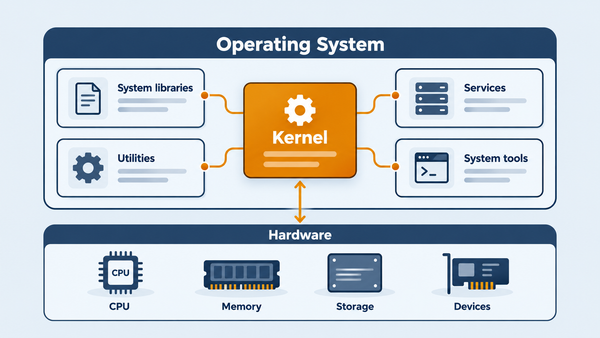
An operating system provides the foundations for running applications. As we explored in our previous articles, What Is an Operating System? and What Is a Kernel?, the kernel manages processes, memory and access to hardware. But applications often need capabilities beyond these fundamental mechanisms.
Imagine a device with two applications: one displays live video from a camera, while the other records it. Both depend on the same hardware, yet they have different responsibilities. They may need a common way to obtain the video stream without each taking control of the camera independently.
The same problem appears when applications need to exchange information or use similar processing functions. Implementing everything separately can duplicate code and increase maintenance effort.
A shared software component can provide those capabilities through a consistent interface. This is one reason middleware exists.
What Is Middleware?
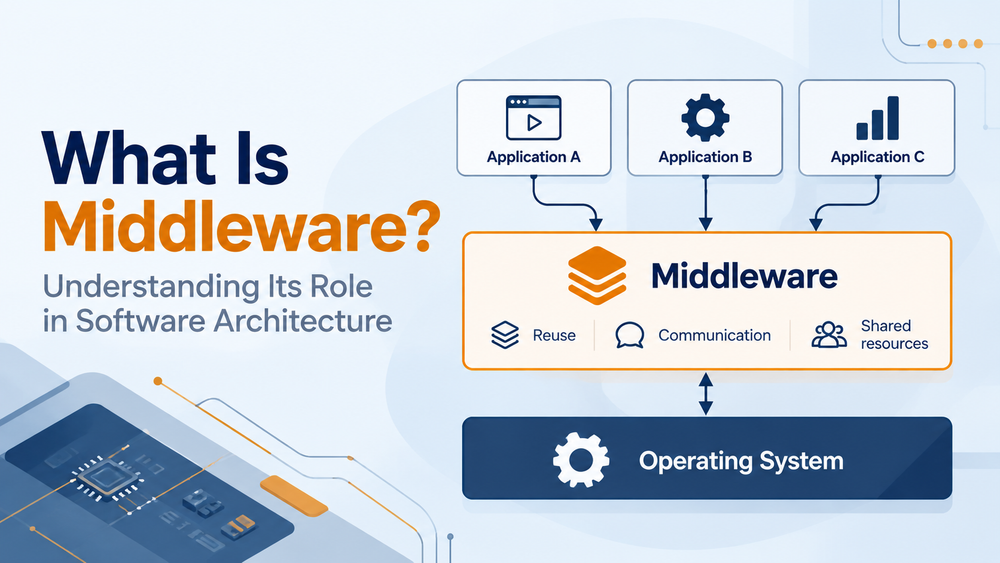
Middleware is software that provides common capabilities or services to applications, helping them reuse functionality, communicate with other components or work with shared resources.
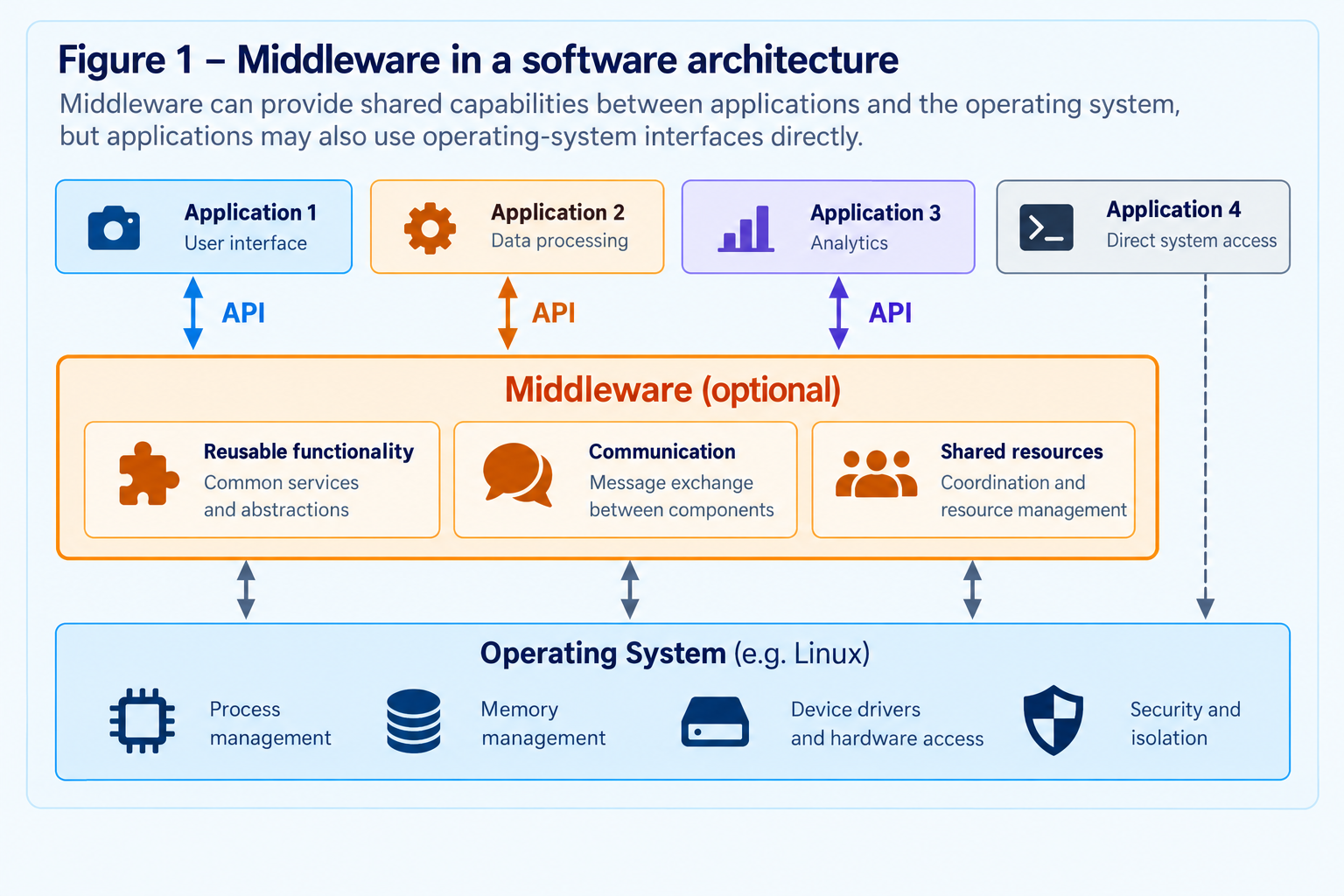
It is often illustrated as a layer between applications and the operating system. That is a useful mental model, but it is not a universal design. Middleware is not a mandatory part of every operating system, and its boundaries are not always sharply defined.
Depending on the architecture, middleware might be a set of libraries, a framework, a service running in its own process or a combination of these. Some applications use it extensively; others call operating-system interfaces directly.
Middleware, APIs, Libraries and Frameworks
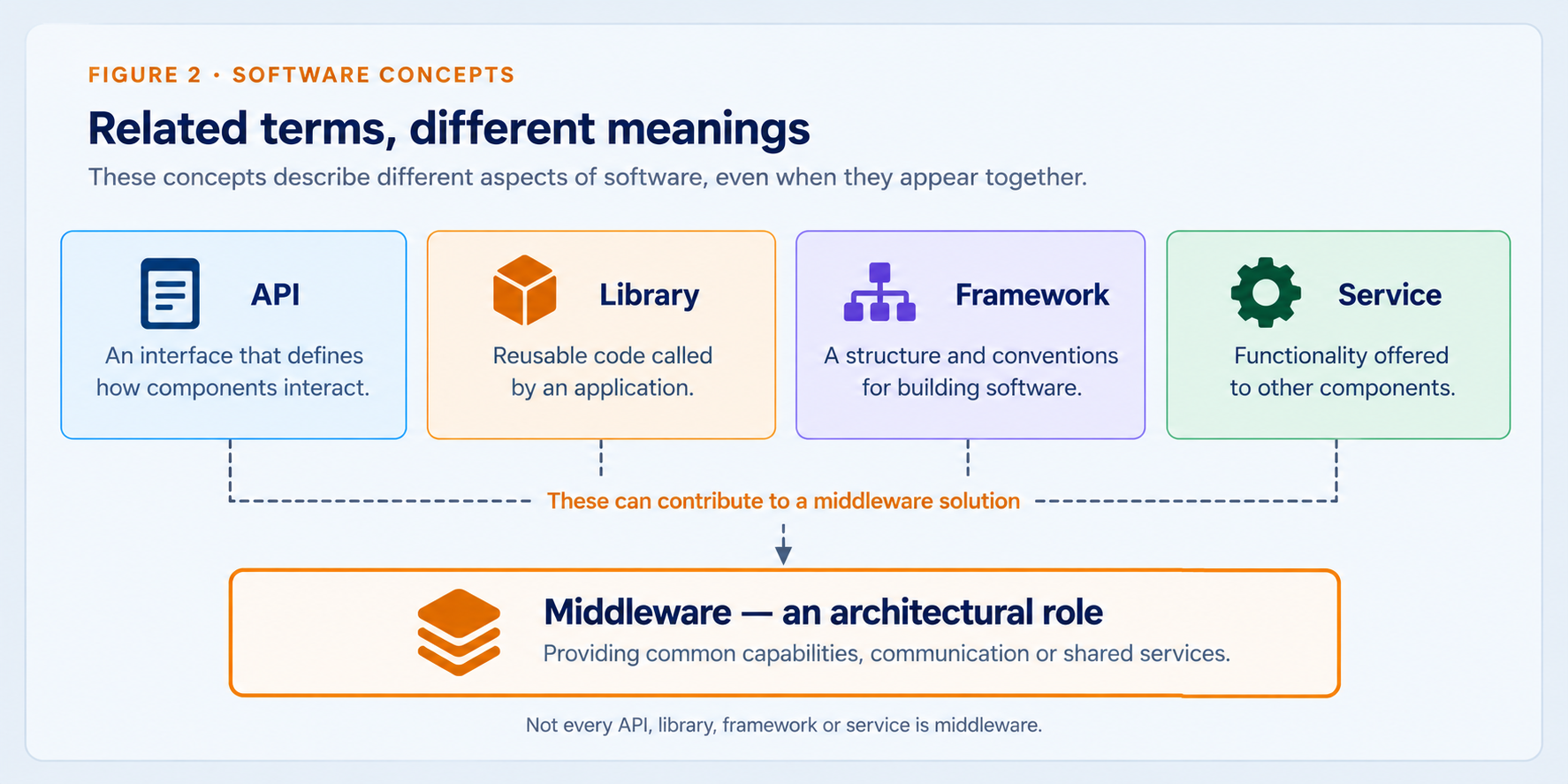
These terms are related, but they do not mean the same thing.
An API (Application Programming Interface) defines how software components interact. A library provides reusable code that an application can call. A framework supplies components, structure and conventions for developing software. A service offers functionality to other components, often through an interface.
Middleware, by contrast, describes a role in the overall architecture: providing common capabilities or services that applications can use.
The categories can overlap. A middleware solution may expose an API, rely on libraries, be organised as a framework and include one or more services. But an API is not automatically middleware, and neither is every library, framework or service.
The operating system is different again: it provides fundamental mechanisms such as process execution, memory management and access to devices. Middleware can build on these mechanisms to offer functionality tailored to the applications above it.
What Does Middleware Actually Do?
Although middleware takes many forms, three common roles help explain its purpose.
1. Providing Abstraction and Reusable Functionality
Applications often need similar functions, such as processing data, handling messages or converting media formats. Middleware can expose reusable components and higher-level interfaces, so each application does not need to implement these operations from scratch.
This reduces duplicated effort and can hide implementation details that are irrelevant to the application itself.
2. Enabling Communication
Independent applications and services may need to exchange requests, responses or events. An operating system already provides communication mechanisms, but middleware can offer more structured ways to use them.
For example, an application might request information from a shared network service rather than manage network connections itself. The communication component carries the request; the service performs the work.
3. Coordinating Shared Resources
Several applications may depend on one resource, such as a camera. The operating system supplies the mechanisms for accessing and protecting the device, but a shared service can provide an additional level of coordination.
In our example, a camera service could capture the video once and distribute the stream to both applications. One application displays it; the other records it. Neither needs to control the hardware independently.
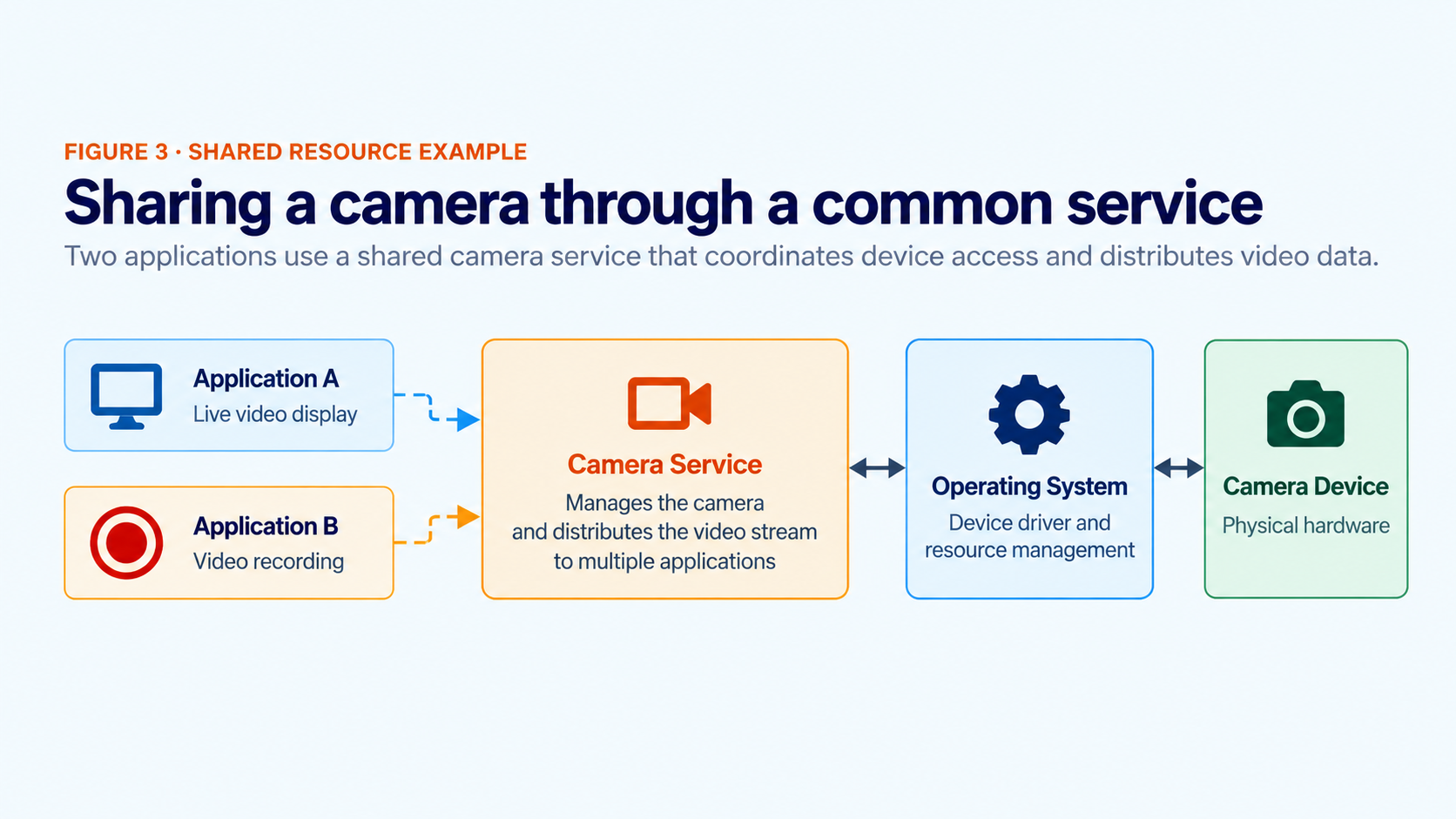
Such a service may also apply rules about how applications use the resource. This does not mean resource sharing always requires middleware: operating systems already support many forms of sharing. Middleware becomes useful when applications need additional coordination, a common interface or reusable behaviour.
Benefits and Trade-offs
Middleware can make software easier to develop and maintain. Shared capabilities avoid duplicated implementations, while clear interfaces help separate application-specific logic from common infrastructure. When multiple applications use the same platform, this separation can make it easier to evolve individual components.
There are costs as well. Additional software brings dependencies, configuration and updates. Services running in separate processes may introduce communication overhead or new failure points. In constrained systems, memory use and startup time can also matter.
The goal is not to add middleware everywhere, but to introduce it when the benefits of reuse, communication or coordination justify its complexity.
From Middleware to Embedded Linux
These ideas are especially useful on embedded platforms, where several applications may need common services or access to limited hardware resources.
The architectural questions are straightforward: which responsibilities belong to the operating system, which should be shared, and which should remain inside each application? The implementation can be more involved.
In our next article, Middleware in Embedded Linux: Shared Services, Resource Management and Hardware Access, we will examine how Linux interfaces, user-space services and middleware components work together in a real embedded platform.
Sources and Further Reading
- Red Hat — What Is Middleware? — An overview of middleware, its responsibilities and its role in application architectures.Red Hat
- MDN Web Docs — Middleware — A concise explanation of middleware and its broad definition across software environments.MDN
- MDN Web Docs — API — Explains application programming interfaces and how software components interact.MDN
- Linux Kernel Documentation — Opening and Closing Video Devices — Documents video device access, resource ownership and the use of a user-space proxy for shared streams.The Linux Kernel documentation