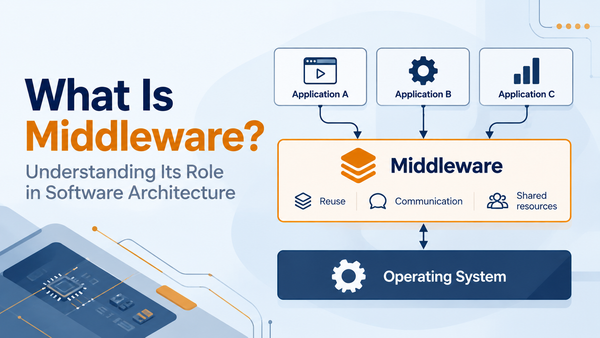

In What Is an Operating System?, we explored how operating systems provide applications with access to fundamental capabilities through system interfaces and libraries. In What Is Middleware?, we introduced middleware as a way to provide reusable functionality and separate common services from application-specific logic.
But how does middleware actually work in an embedded Linux system?
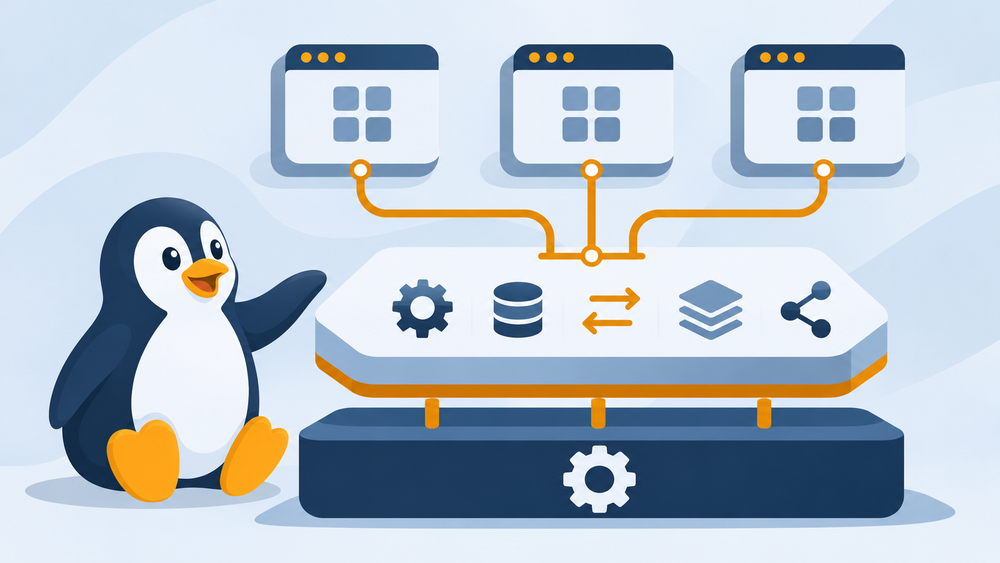
Linux provides the mechanisms needed to execute applications, access system resources and communicate between processes. Middleware builds on these mechanisms to offer higher-level APIs and shared services. Understanding how these components interact helps explain where middleware fits into an embedded Linux architecture.
From Linux Interfaces to Middleware
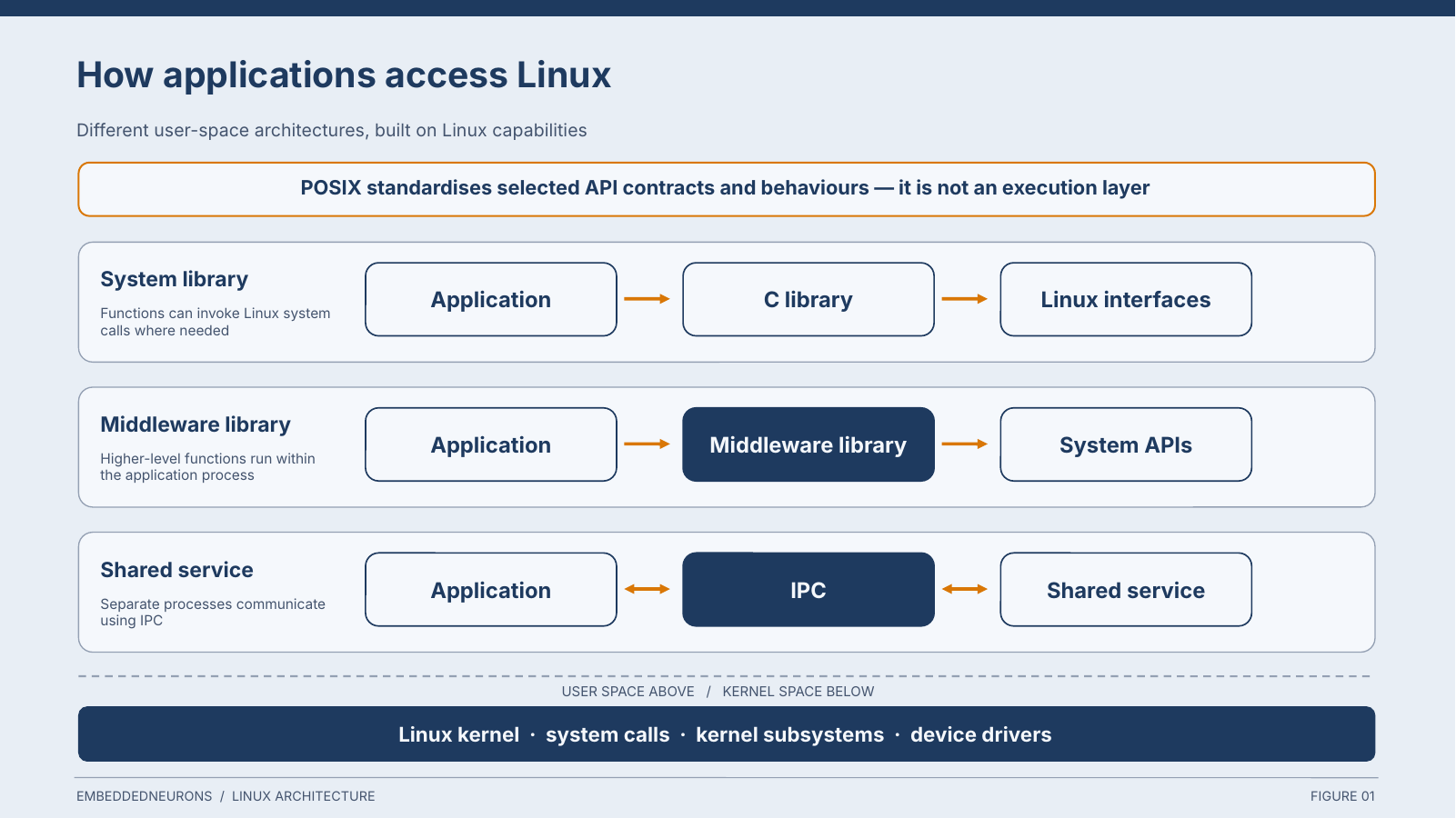
Linux separates execution into kernel space and user space. The kernel manages fundamental resources such as memory, processes and hardware devices, while applications normally execute in user space.
Applications access operating-system functionality through programming interfaces. System libraries, such as the C library, provide convenient functions for common operations, while middleware libraries offer higher-level functionality built on these interfaces.
Middleware does not form a mandatory layer of Linux. An application can use system libraries directly, call functions provided by a middleware framework or communicate with an independent service. These approaches can also be combined.
APIs, POSIX and System Calls
An Application Programming Interface (API) defines how software components interact, including the operations available and their expected behaviour.
POSIX (Portable Operating System Interface) standardises many operating-system interfaces to improve source-code portability between compatible systems. It defines functions for file operations, process management, threads and inter-process communication.
On Linux, C libraries such as glibc or musl implement many POSIX interfaces. Some functions invoke Linux system calls, which provide controlled entry points into the kernel, while others execute entirely in user space.
For example, the POSIX read() interface is normally implemented using the corresponding Linux system call. However, POSIX defines the programming contract, not how the kernel must implement it. Linux also exposes non-POSIX interfaces for functionality specific to the operating system.
Middleware can use both standardised and Linux-specific APIs to provide abstractions suited to an embedded product.
Inter-Process Communication in Linux
Libraries provide reusable functionality inside an application's process. However, independent processes often need to exchange information or cooperate with services running elsewhere in the system.
Linux normally isolates processes using separate virtual address spaces. To communicate, they use mechanisms collectively known as Inter-Process Communication (IPC).
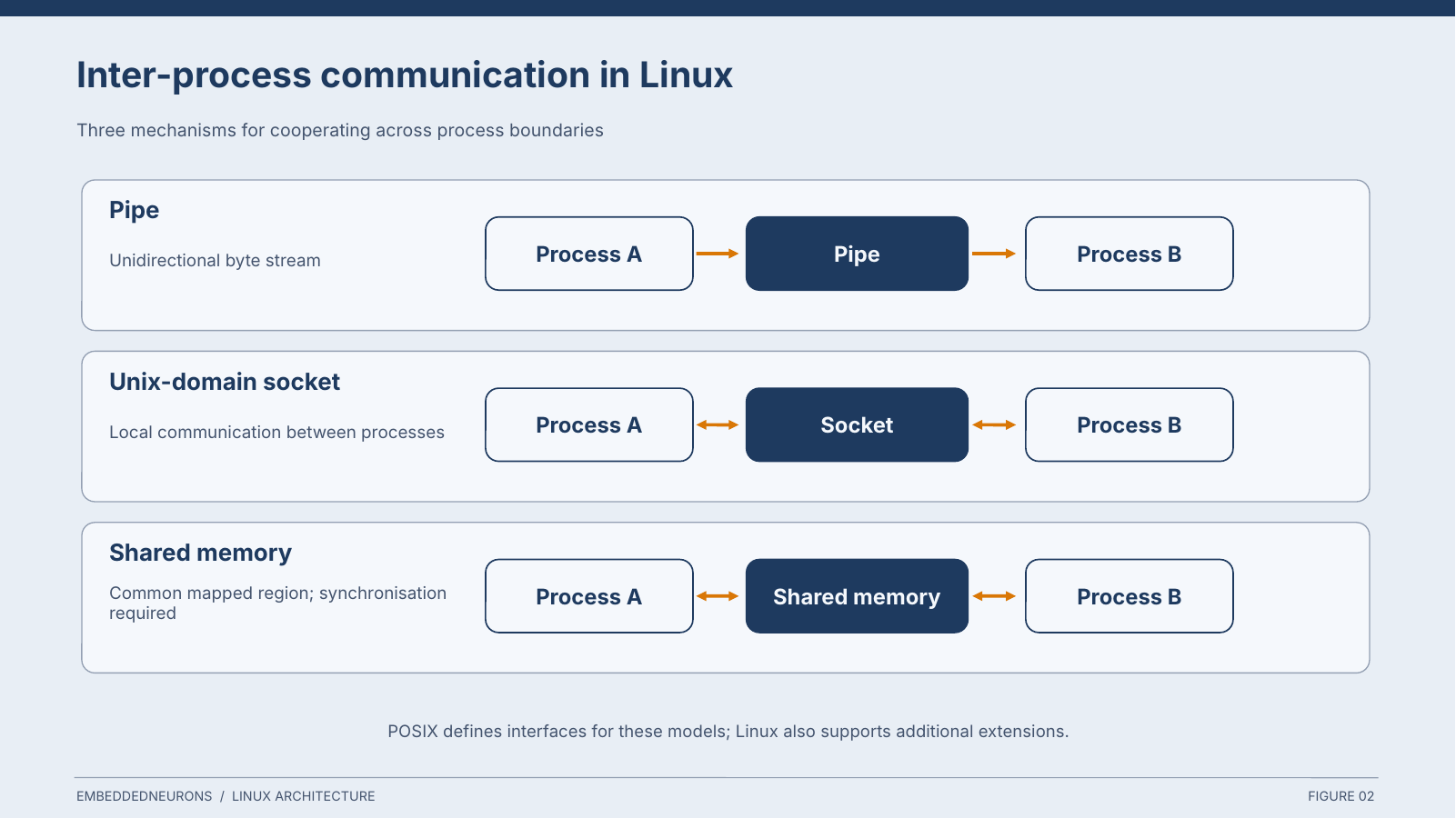
Several IPC mechanisms are available:
- Pipes transport a byte stream in one direction, commonly between related processes.
- Unix-domain sockets provide communication between local processes, supporting bidirectional exchanges and different socket types.
- Shared memory allows processes to access a common memory region, avoiding the need to send every piece of data through a messaging channel.
POSIX defines interfaces for these forms of communication, while Linux provides additional capabilities and extensions.
Each mechanism has different characteristics. Pipes are simple, sockets offer flexible communication between applications and services, and shared memory can be efficient for large data transfers but requires appropriate synchronisation.
These mechanisms can also work together. For example, applications may exchange control messages through a socket while using shared memory for data buffers.
Linux provides the communication mechanisms, but applications must still define how messages are structured and interpreted.
From IPC to D-Bus
IPC mechanisms allow processes to exchange data, but they do not define a common protocol for identifying services, invoking operations or distributing notifications. As a system grows, implementing these conventions separately for every service can become difficult to maintain.
A message bus provides a higher-level communication infrastructure. D-Bus is a widely used example in Linux systems.
D-Bus builds on IPC mechanisms, commonly Unix-domain sockets, and defines a structured messaging model. Applications can identify services by name, invoke methods exposed through interfaces and receive signals when events occur.
For example, an application can request information from a shared system service through a method call. Other applications can subscribe to signals announcing changes without continuously requesting updates.
D-Bus handles message transport and routing, but the service itself implements the requested functionality. It may use POSIX interfaces, Linux-specific APIs or additional middleware libraries to perform its operations.
D-Bus is not mandatory. Linux services can communicate through other protocols, and simpler systems may not need a message bus at all.
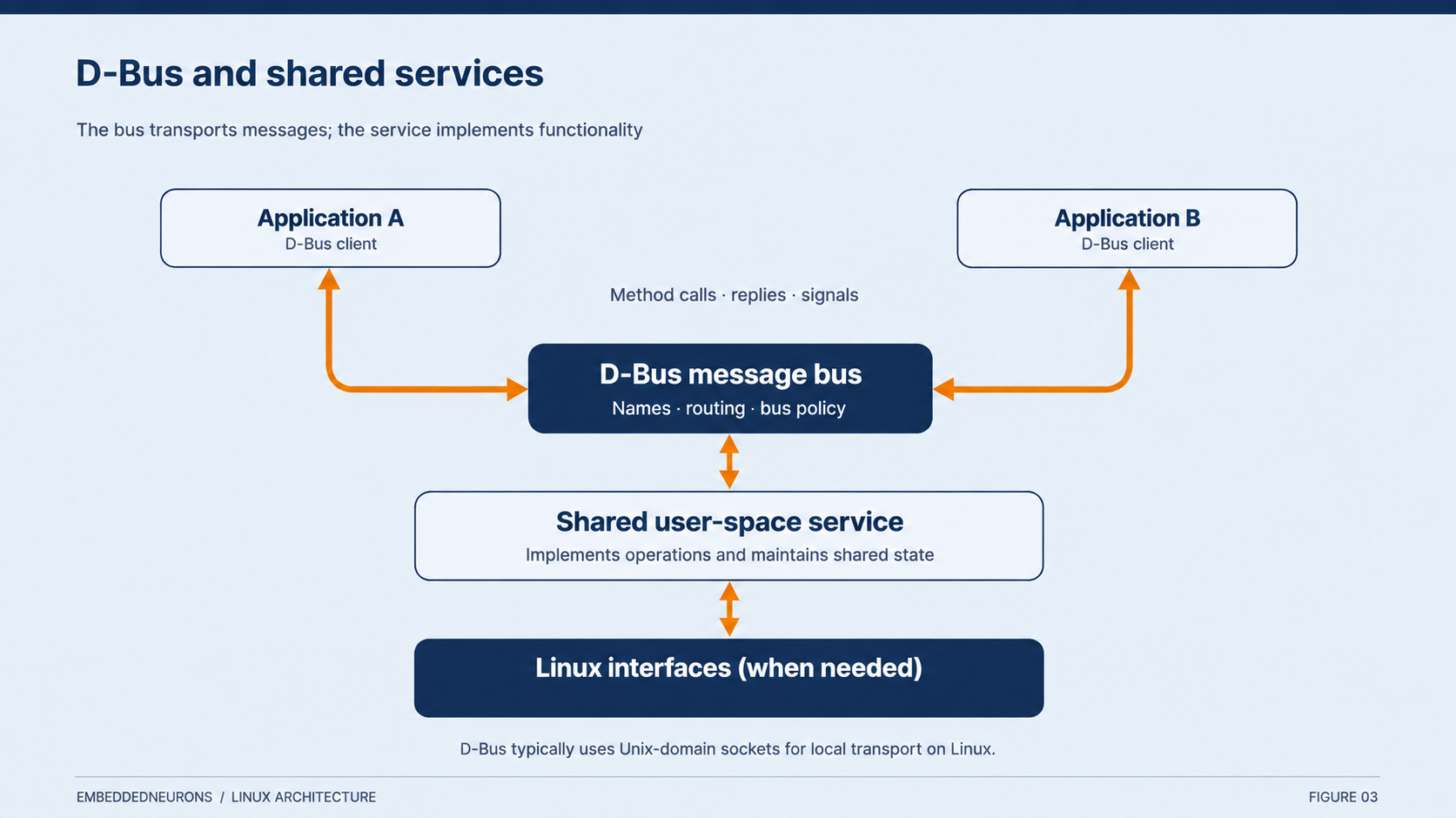
Libraries, Daemons and Shared Services
Middleware can be implemented as a library running inside an application or as an independent service.
A middleware library provides reusable functions that applications call directly. A daemon is a background process that can expose functionality to other applications through IPC. Multiple clients can therefore use a shared implementation without each maintaining its own copy of the service's state.
Shared services may also coordinate requests or apply application-specific policies. Linux already provides mechanisms for permissions, scheduling and resource management, but these do not necessarily define how a particular product should organise its application-level responsibilities.
Centralising functionality can improve maintainability and consistency, although it introduces additional considerations. IPC adds communication overhead, services consume resources, and applications must handle service failures and access permissions.
The appropriate architecture depends on the product. A simple application may only need a library, while a system with several cooperating applications may benefit from shared services.
From Middleware to Embedded Linux Platforms
An embedded Linux platform combines the kernel, system libraries, middleware frameworks, background services and applications. These components must be selected, configured and maintained together.
The Yocto Project provides tools and metadata for building customised Linux distributions that integrate these components. It does not define the middleware architecture, but helps turn architectural decisions into a coherent software platform.
Understanding APIs, POSIX, IPC and shared services is therefore an important step towards the next challenge: building and maintaining a complete embedded Linux system.